40 logistics & shipping abbreviations every importer should know
Reference8 min read
In supplier chats, invoices and documents, logistics speaks in abbreviations: ETA, FCL, BL, TEU… Not knowing what they mean is an easy way to miss something important. Here's a short glossary — 40 abbreviations an importer meets most often, explained in plain language.
We've grouped them by topic so they're easy to scan. Incoterms are here too, briefly — with a full breakdown in a separate article.
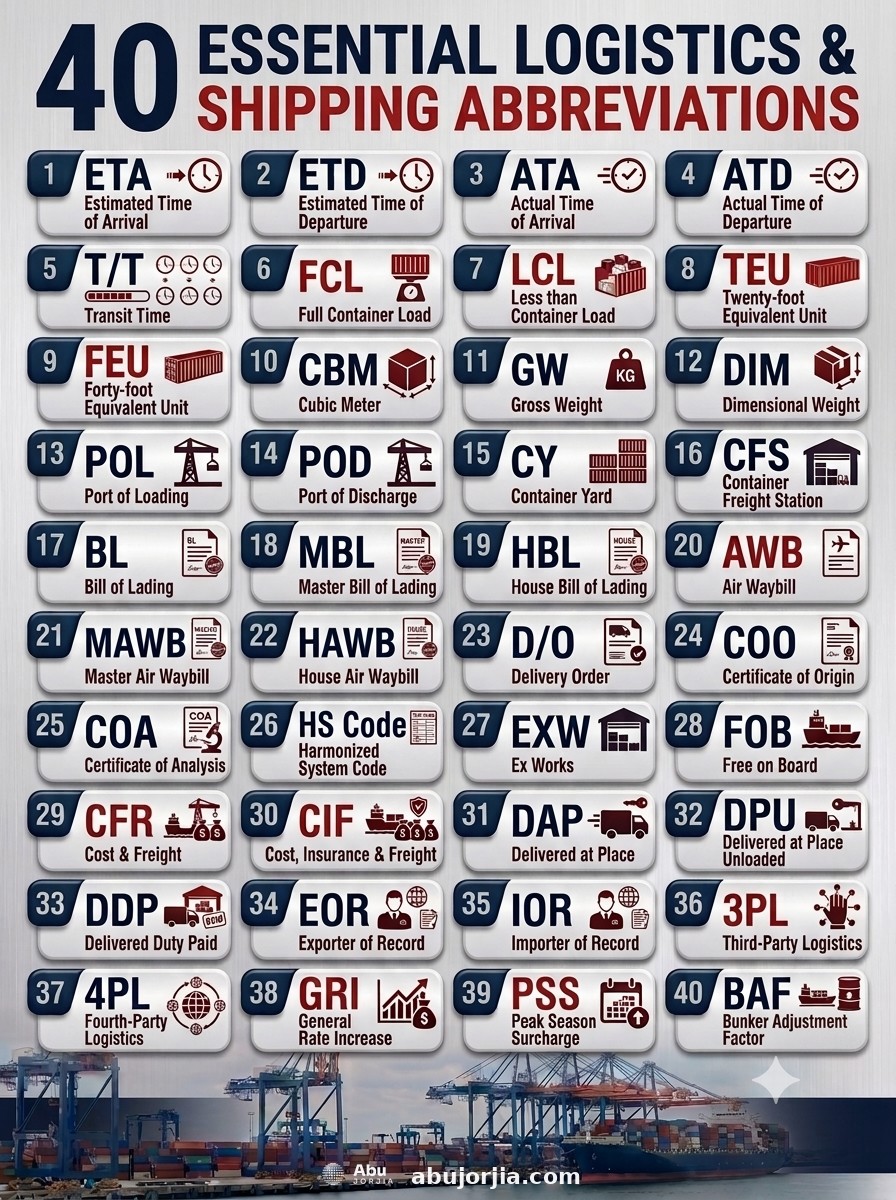
40 logistics & shipping abbreviations — save it as a cheat sheet
Times & status
ETAEstimated Time of Arrival — when the cargo is expected to arrive at destination.
ETDEstimated Time of Departure — when the cargo is expected to leave the origin.
ATAActual Time of Arrival — when the cargo actually arrived.
ATDActual Time of Departure — when the cargo actually departed.
T/TTransit Time — how many days the cargo travels from departure to arrival.
Containers & volume
FCLFull Container Load — you rent a whole container for your cargo alone.
LCLLess than Container Load — your cargo shares a container with others; you pay for your share.
TEUTwenty-foot Equivalent Unit — a unit equal to one 20-foot container, used to measure volumes.
FEUForty-foot Equivalent Unit — same for a 40-foot container (= 2 TEU).
CBMCubic Meter — cargo volume in cubic metres; often the basis for LCL rates.
GWGross Weight — weight of the goods including packaging.
DIMDimensional Weight — «volumetric weight»; for light bulky cargo the rate is based on this, not actual weight.
Ports & terminals
POLPort of Loading — the port where cargo is loaded onto the vessel.
PODPort of Discharge — the port where cargo is discharged. (POD can also mean Proof of Delivery — check the context.)
CYContainer Yard — the yard in a port where containers are stored.
CFSContainer Freight Station — a warehouse where LCL cargo is consolidated into and stripped out of containers.
Documents
BLBill of Lading — the key sea-freight document: contract, receipt and title to the goods.
MBLMaster Bill of Lading — bill of lading issued by the carrier (line) to the forwarder.
HBLHouse Bill of Lading — bill of lading issued by the forwarder to the client.
AWBAir Waybill — the air-freight equivalent of a bill of lading.
MAWBMaster Air Waybill — air waybill issued by the airline.
HAWBHouse Air Waybill — air waybill issued by the forwarder to the client.
D/ODelivery Order — the document releasing cargo to the consignee at the port or warehouse.
COOCertificate of Origin — proves in which country the goods were made (affects duties).
COACertificate of Analysis — certifies the composition and quality of the goods (chemicals, food, etc.).
HS CodeHarmonized System Code — international product code used to calculate duties and clear customs.
Incoterms (delivery terms)
EXWEx Works — the buyer collects from the seller's premises and ships everything themselves.
FOBFree On Board — the seller loads onto the ship; risk and freight then pass to the buyer.
CFRCost & Freight — the seller pays freight to the destination port (no insurance).
CIFCost, Insurance & Freight — same plus (minimum) insurance.
DAPDelivered At Place — the seller delivers to the place; the buyer clears customs.
DPUDelivered At Place Unloaded — same plus unloading is on the seller.
DDPDelivered Duty Paid — the seller delivers and clears customs — turnkey.
EORExporter of Record — the entity officially responsible for the export in the origin country.
IORImporter of Record — the entity officially responsible for the import and duties in the destination country.
3PLThird-Party Logistics — an outside contractor handling transport, warehousing and customs (like ABU JORJIA).
4PLFourth-Party Logistics — a contractor that manages a client's entire logistics and coordinates other 3PLs.
Rates & surcharges
GRIGeneral Rate Increase — a general increase in freight rates by the lines (usually announced ahead).
PSSPeak Season Surcharge — a surcharge during peak season when shipping demand is highest.
BAFBunker Adjustment Factor — a fuel surcharge on freight, tied to the price of marine bunker fuel.
How we help
All these abbreviations are our daily work. ABU JORJIA has shipped cargo from Asia and the UAE to Ukraine since 2010: we'll choose the format, handle documents, clear customs and explain every line in plain language. We'll price your route and rate within 24 hours.
Need help with shipping or paperwork?
Describe your cargo and route — we'll quote the rate and handle everything within 24 hours.