Incoterms explained in plain language: who is responsible for what
Incoterms are international rules that use one short code to define who is responsible for delivery, costs, risk and customs at each stage of a shipment. The term in your contract answers the key question: up to which point does the seller pay and bear the risk, and from which point do you.
The version in force is Incoterms 2020 (that's what contracts should cite). Note: the rules cover only logistics — delivery, costs and the transfer of risk; they do not govern ownership or payment terms.
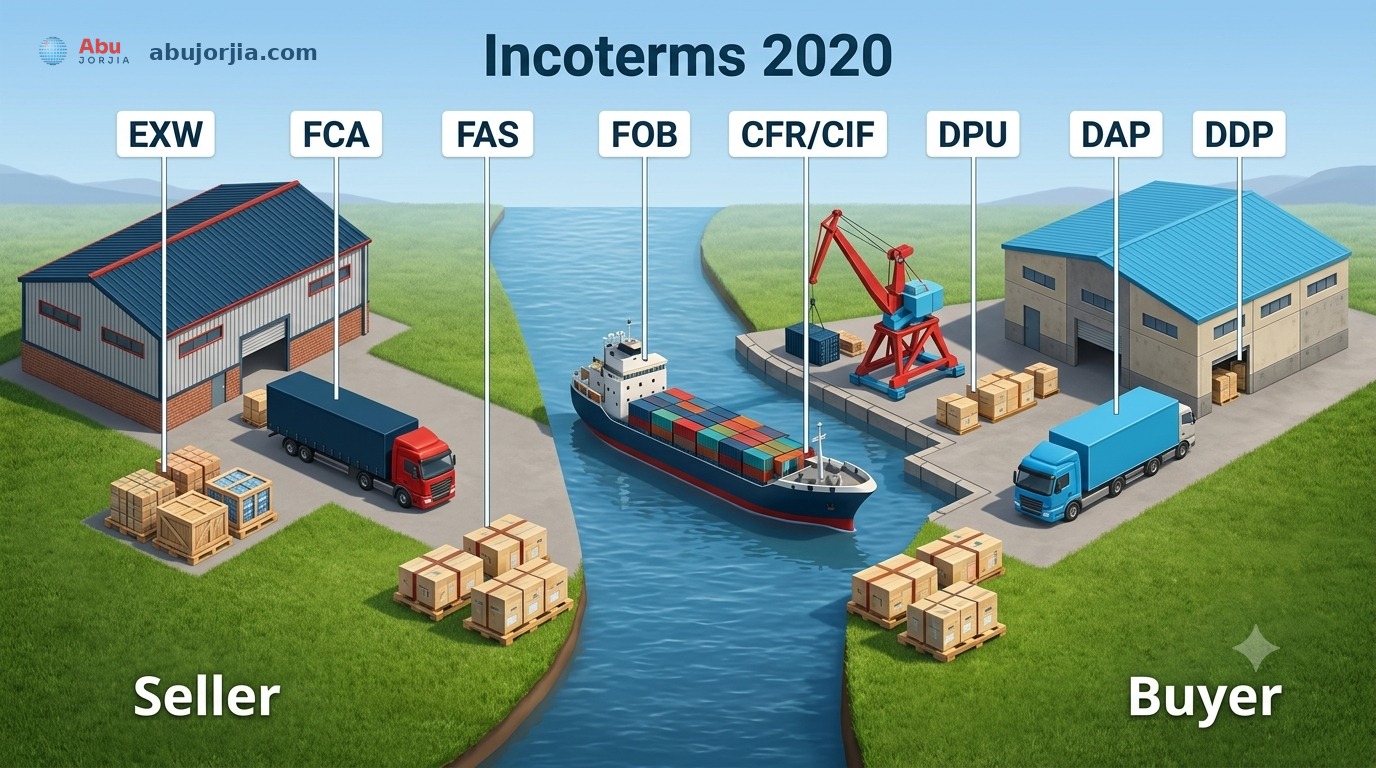
In the diagram the terms run from the seller (left) to the buyer (right): the 'further' the term, the more the seller takes on. Let's go through each one.
Every term, one by one
EXW — Ex Works
The seller makes the goods available at their warehouse — and that's it. Loading, collection, carriage, export and import customs, and all risk and cost are on the buyer. The 'easiest' term for the seller and the most demanding for the buyer. Suits you if you have your own forwarder and full control of the logistics.
FCA — Free Carrier
The seller loads the goods and hands them to the buyer's carrier at an agreed place (their warehouse or a terminal) and handles export. Risk passes to the buyer at handover. One of the most convenient and popular terms — especially for container and multimodal shipping.
FAS — Free Alongside Ship
The seller delivers the goods to the port of shipment and places them alongside the vessel (on the quay). From there, cost and risk are on the buyer. Sea and inland waterway only; rare in practice, mostly for bulk and oversized cargo.
FOB — Free On Board
The seller delivers to the port and loads the goods onto the ship. Once on board, risk and onward costs (freight, insurance, unloading) pass to the buyer. A classic for sea shipments from Asia: the buyer controls the freight and often saves. Sea transport only.
CFR — Cost and Freight
The seller pays for carriage and sea freight to your destination port. The catch: risk passes to the buyer back at the port of shipment, when the goods are loaded — so you bear the risk in transit even though the seller pays the freight. The seller does not arrange insurance. Sea transport only.
CIF — Cost, Insurance and Freight
Same as CFR, plus the seller arranges cargo insurance in transit — but at minimum cover. Risk, as with CFR, passes to the buyer at the port of shipment. Handy if you want the seller to bring the goods to your port with basic insurance. Sea transport only.
DPU — Delivered at Place Unloaded
The seller delivers to an agreed place at your end and unloads the goods. All cost and risk up to unloading are on the seller; the buyer handles import customs. The only term where unloading is the seller's duty. In the 2020 edition it replaced the old DAT.
DAP — Delivered at Place
The seller delivers to a named place at your end, ready for unloading. The buyer handles unloading and import clearance. Convenient when you want the goods almost 'to the door' but clear customs yourself.
DDP — Delivered Duty Paid
Maximum responsibility on the seller: they deliver, and arrange and pay import customs and duties — turnkey. Minimum effort for the buyer, but usually the most expensive option, and the seller must be able to clear customs in your country.
Two terms aren't shown in the diagram — CPT and CIP (Carriage Paid To / Carriage and Insurance Paid To). They are the equivalents of CFR and CIF but for any mode of transport, not just sea. For container and multimodal shipping, these are the more correct choice.
How to choose the right term
- New to this, or without your own logistics team — DAP/DDP is easier: less hassle, the seller delivers almost to your door.
- Want control and often savings — FOB or FCA: you (or your forwarder) arrange delivery and don't overpay for it inside the goods' price.
- Always check who bears the risk in transit and whether there's insurance: with FOB/CFR the risk is yours from loading.
A common mistake
The main misconception is thinking Incoterms decide when the goods 'become yours' or when to pay. They don't — they only cover delivery, costs and risk. And always state the version and place, e.g. 'FOB Shanghai, Incoterms 2020'.
How we help
ABU JORJIA has shipped cargo from Asia and the UAE to Ukraine since 2010 and helps you choose the right term for your deal. For imports from China, India and the UAE, FOB or FCA is usually the best value — and we take on the delivery leg, customs and insurance. We'll price your route and rate within 24 hours.