Eurasian transport corridors: Northern, Middle, Southern, INSTC — compared
Transport corridors are no longer just routes — today they are strategic assets, and competition increasingly runs between corridors rather than countries. Which corridor cargo takes from Asia to Europe and Ukraine decides the timing, cost, reliability and political risk. We break down the main Eurasian transport corridors, compare them and explain why the Middle Corridor is now in the spotlight.
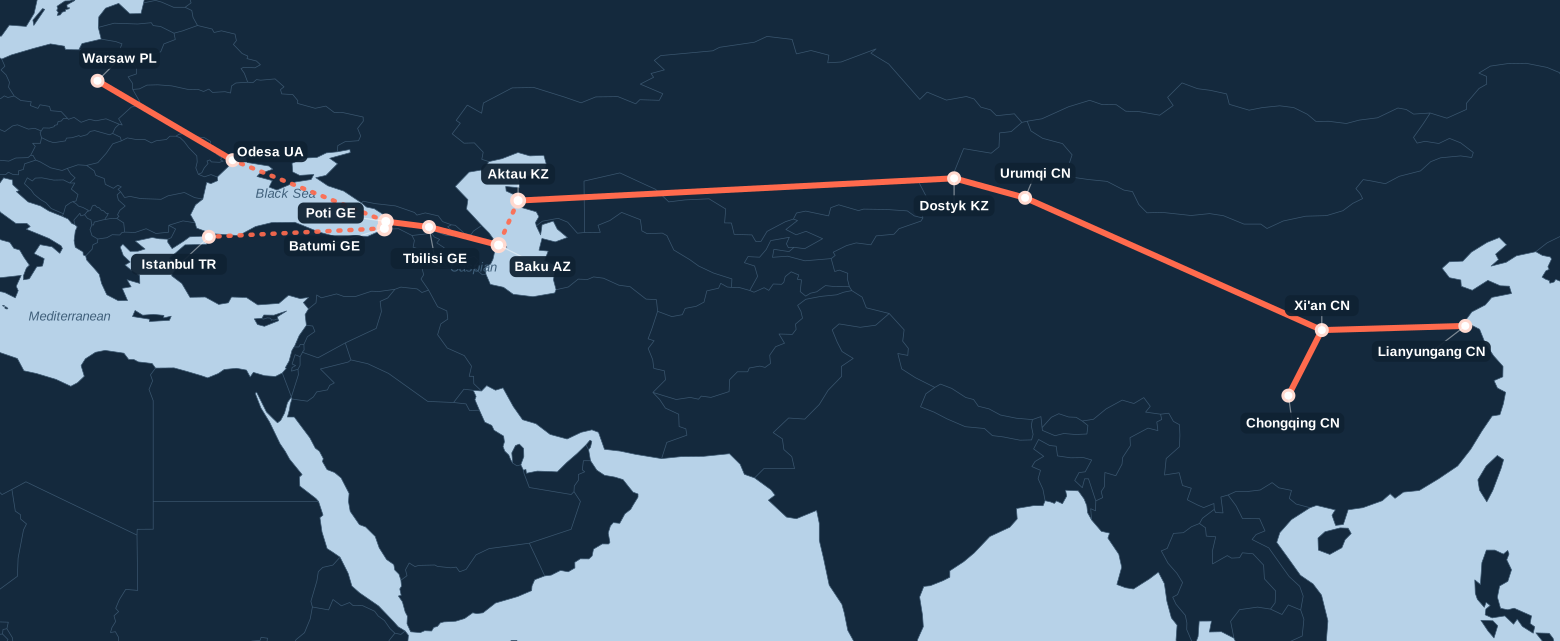
What transport corridors are and why they compete
A transport corridor is a stable route with infrastructure (railways, ports, highways, transfer points) for a regular flow of cargo between large regions. Several such corridors have formed between Asia and Europe, each offering its own balance of speed, cost, capacity and geopolitical resilience. Since 2022 it is resilience — the ability to move cargo around sanctioned zones — that has become the deciding factor.
Corridor comparison table
| Corridor | Route (short) | Bypasses Russia | Notes |
|---|---|---|---|
| Northern | China → Kazakhstan → Russia → Belarus → Poland/EU | No | Fastest rail, but depends on Russia |
| Middle (TITR) | China → Kazakhstan → Caspian → Azerbaijan → Georgia → Turkey/EU and Black Sea → Ukraine | Yes | Bypasses Russia; multimodal; growing fastest |
| Southern | China → Central Asia → Iran → Turkey → EU | Yes | Via Iran; sanctions and infrastructure limits |
| INSTC (North–South) | India → Iran → Caspian → Russia/EU | Partly | North–south axis, links India with Russia and Europe |
| TRACECA | Europe → Black Sea → Caucasus → Caspian → Central Asia | Yes | EU programme; the Middle Corridor is one of its branches |
Based on EDB and UNECE data (Eurasian transport network review, 2026).
Northern Eurasian Corridor
The classic China–Europe rail route: via Kazakhstan, Russia and Belarus to Poland and on to the EU. For a long time it was the fastest and cheapest overland path, carrying most China–EU container trains. The downside is full dependence on transit through Russia: since 2022, sanction, insurance and reputational risks have pushed many shippers to look for an alternative.
Middle Corridor (TITR / Trans-Caspian)
The Middle Corridor is the Trans-Caspian International Transport Route (TITR): China → Kazakhstan → the Caspian Sea (Aktau/Kuryk → Baku) → Azerbaijan → Georgia, then split into two legs — by the Baku–Tbilisi–Kars railway to Turkey and the EU, or via the ports of Poti and Batumi across the Black Sea to Ukraine. The key advantage is that the route fully bypasses Russia. It is a multimodal corridor (ferry + rail + sea) and it is growing fastest of all: see Middle Corridor — explained and the corridor grows 6x. Formally the Middle Corridor is one of the branches of the TRACECA programme.
Southern Eurasian Corridor
A route from China through Central Asia and Iran to Turkey and Europe. It also bypasses Russia but runs into sanctions on Iran and unfinished infrastructure on some sections. Its growth is tied to new projects such as the China–Kyrgyzstan–Uzbekistan railway.
INSTC — the North–South Corridor
The International North–South Transport Corridor (INSTC) is a north–south axis rather than east–west: from India through Iran and the Caspian to Russia and on to Europe. It shortens the India–Russia route compared with the Suez Canal. It is not used directly for China–Ukraine delivery, but it is part of the wider Eurasian picture.
TRACECA
TRACECA (Transport Corridor Europe–Caucasus–Asia) is an intergovernmental programme backed by the EU and launched back in the 1990s: Europe → Black Sea → Caucasus → Caspian → Central Asia. It is essentially an umbrella for routes that bypass Russia, and the Middle Corridor is one of its key branches. That is why Georgia, with its ports and railways, sits at the centre of the system.
Why the Middle Corridor is in focus now
After 2022 demand shifted to routes bypassing Russia, and the Middle Corridor became the main beneficiary: it is shorter than the Southern, more resilient than the Northern and actively backed by the EU. Georgia is the heart of this corridor: the ports of Poti and Batumi, the BTK railway, the Caspian crossing and the link to Turkey and the Black Sea. For delivery to Ukraine it is a reliable path from Asia that does not depend on Russian transit. How it all connects in practice is in multimodal transport.
Development prospects
There is no single winner — each corridor has its niche. The Northern remains technically fastest but politically limited. The Middle Corridor is the main strategic choice for bypassing Russia and is growing fastest, though it is held back by bottlenecks: the capacity of the Caspian ferries and breaks of gauge. This is where the main investment goes — port expansion (the Poti mega-port, deep-sea Anaklia), the BTK upgrade and EU support under the Global Gateway initiative. As bottlenecks clear, the Middle Corridor’s share of Asia–Europe trade will grow while times and costs fall.
Summary
Choosing a corridor means choosing a balance of speed, cost and risk. For cargo from Asia to Ukraine bypassing Russia, the Middle Corridor via Georgia is currently the best option. ABU JORJIA will build the Middle Corridor route end-to-end — send a request.
Get a delivery quote