Railway track gauge: 1435, 1520 and others — what it means for cargo
Track gauge is the distance between the inner faces of the rails. It decides whether a wagon can roll on across a border or the cargo has to be transferred. There is no single world standard, and Asia–Europe routes cross several gauges. We break down which railway gauge is used where, where the break of gauge occurs and what it means for delivery to Ukraine along the Middle Corridor.
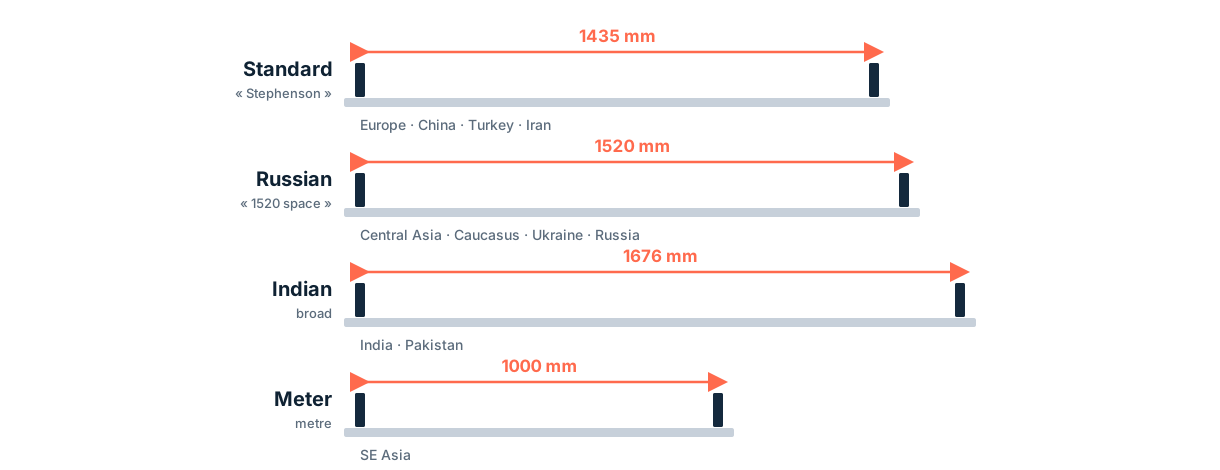
What track gauge is and why it varies
Track gauge is the fixed distance between the rails that every wagon and locomotive is built for. No single world standard emerged for historical reasons: countries built railways at different times, by different engineers, and often deliberately chose a different gauge for military security. As a result a train cannot simply roll from one gauge onto another.
Main gauges in the world
| Gauge | Name | Where used |
|---|---|---|
| 1435 mm | Standard (Stephenson) | Europe, Turkey, China, Iran |
| 1520 mm | Russian, broad (“1520”) | Central Asia, Caucasus, Ukraine, Russia, Mongolia |
| 1676 mm | Indian broad | Pakistan, India, Bangladesh |
| 1000 mm | Metre | SE Asia (Thailand, Vietnam, Myanmar), part of India |
| 1668 mm | Iberian | Spain, Portugal |
Finland uses 1,524 mm — effectively the same family as 1,520 mm.
1435 vs 1520 — the key pair for Asia–Europe
On the route from Asia to Europe and Ukraine two standards meet. The standard gauge 1435 mm covers China, Turkey, Iran and all of Europe; importantly, the Chinese, Turkish and European gauges are one and the same width, with no break between them. The broad gauge 1520 mm covers the whole post-Soviet space: Central Asia, the Caucasus (including Georgia and Azerbaijan), Ukraine and Russia. It is the boundary between the “1520 space” and standard gauge that creates the bottlenecks.
Break of gauge: where and how
A break of gauge is a place where the width changes and cargo cannot pass without a transfer. The main points on Asia–Europe routes:
| Border | Gauge change | Point |
|---|---|---|
| China ↔ Kazakhstan | 1435 ↔ 1520 | Dostyk / Khorgos |
| Azerbaijan/Georgia ↔ Turkey | 1520 ↔ 1435 | Kars (BTK) |
| Iran ↔ Turkmenistan | 1435 ↔ 1520 | Sarakhs |
| Iran ↔ Pakistan | 1435 ↔ 1676 | Zahedan |
| China ↔ Mongolia | 1435 ↔ 1520 | Erlian / Zamyn-Uud |
The transfer is done two ways: container transshipment by crane from a platform of one gauge to another (fast, which is why containerisation removes most of the problem) and bogie exchange — the wagon is lifted and its wheelsets swapped for the other gauge. These are planned operations, but they add time and cost.
Gauge on the Middle Corridor and the way to Ukraine
The route China → Central Asia → Caspian → Georgia → Ukraine is convenient by gauge: the change happens only once — at the China–Kazakhstan border (Dostyk/Khorgos). After that it is all “1520 space” — Kazakhstan, the Caspian crossing, Azerbaijan, Georgia, up to the ports of Poti and Batumi — one gauge. Ukraine is also 1520 mm, and the sea leg has no gauge at all. If cargo continues to Turkey and the EU by the Baku–Tbilisi–Kars railway, a second break (1520 → 1435) happens at Kars. The full route is in Middle Corridor — explained.
Development prospects
The gauge problem is easing. The main trend is containerisation: a container is craned across in minutes, so different gauges barely slow container trains. Automated transfer stations and modern transshipment points at the key breaks (Dostyk/Khorgos, Kars) are being developed and their capacity is growing. Projects to extend standard gauge 1435 mm deeper into Asia for a seamless link to the European network are under discussion. All of this speeds up and cuts the cost of delivery along the Middle Corridor.
Summary
Different gauges are not an obstacle but a matter of planning the route well. On the way from Asia to Ukraine via the Middle Corridor the gauge changes just once, and containers clear the break quickly. ABU JORJIA will build a route with minimal transshipments — send a request.
Get a delivery quote